
Checking for a Warrant in Bristol County
Every Bristol County warrant check begins at the court that holds the case. Massachusetts offers no public county list or statewide warrant search. The clerk-magistrate counter at the issuing court is the one channel that can confirm whether a warrant is still active.
- Find the court on the summons, complaint, citation, or old docket, and copy the docket number exactly.
- Run the case in the Massachusetts Trial Court case access portal by case number first, then by name.
- Ask the clerk-magistrate's office whether the docket shows a default, a warrant, or a recall, and what the court requires to remove it.
- For a family or child-support matter, call the Probate and Family Court registry, because a contempt capias lives in that file.
- For custody or bail after an arrest, call the Bristol County Sheriff's Office, which cannot recall a warrant but can explain bail.
Note: Have the full legal name, date of birth, docket number, and any payment receipt ready before you call or visit a court counter.
Why Bristol County Has No Warrant Search
Massachusetts keeps its working warrant record inside the Warrant Management System. Clerks enter warrant information there. Police and the Registry of Motor Vehicles draw on it, and any recall or removal updates the same system. The public cannot run a name search against it. What the public gets is a case index instead. The Trial Court portal shows dockets, court locations, and case events, and the state warns that online information may not be current or official. The official docket search steps lay out the fields that appear in the form, which is what a Bristol County reader can actually use.
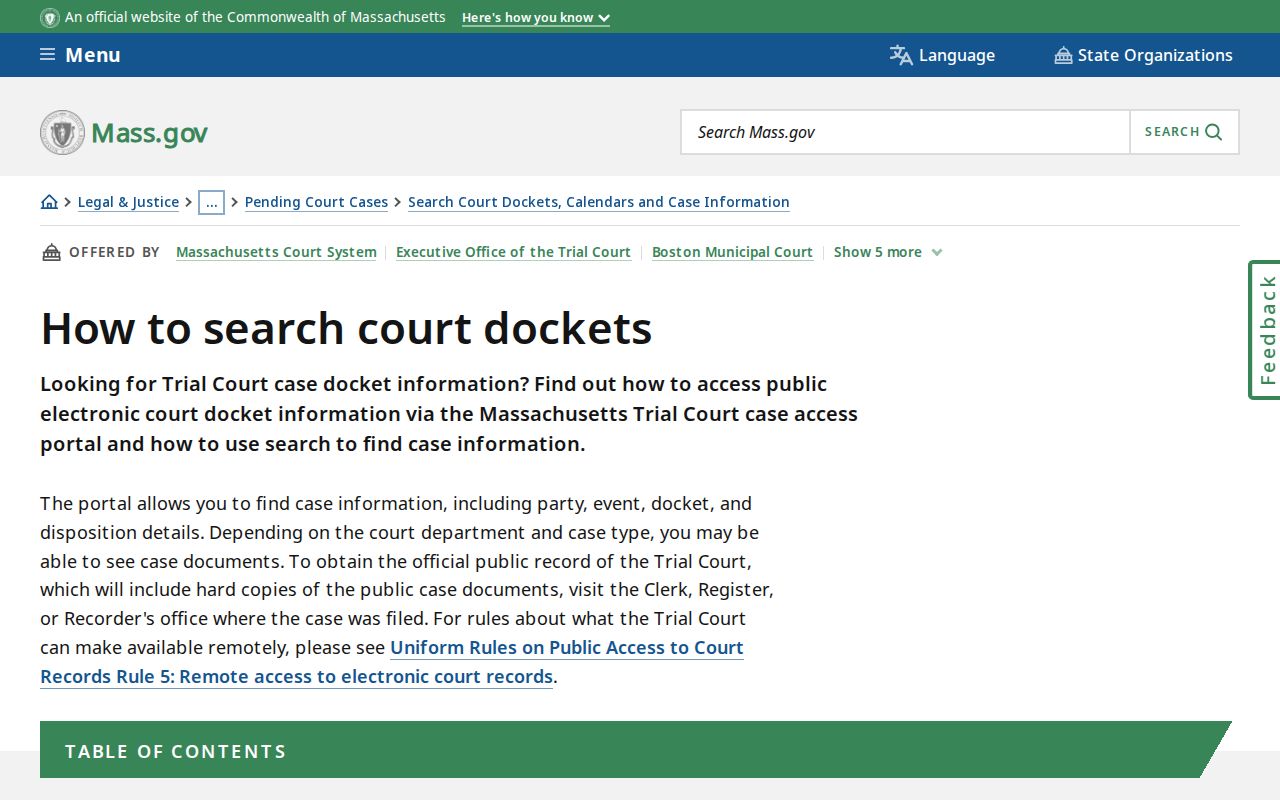
A criminal docket usually demands the exact case number. The portal works best once you read the paper in your hand and any Bristol County code on it.
| Search Field | Type | Required | Notes |
|---|---|---|---|
| Court Department | Dropdown | Yes | District, Superior, Probate and Family, or Juvenile. |
| Court Division and Location | Dropdown | Yes | Name the Bristol location, not just the county. |
| Case Number | Text | Preferred | The strongest key for a criminal docket. |
| Name | Text | Optional | A name hit is an index lead, never an identity match. |
| Ticket or Citation Number | Text | Motor vehicle cases | Useful when the case began as a citation. |
Note: A name that does not appear in the public index is not proof that no warrant exists.
Bristol County Warrant Types
Massachusetts courts usually say default warrant where other states say bench warrant. A capias turns up mainly in family contempt files in Bristol County.
| Warrant Type | How It Arises | Who Issues It |
|---|---|---|
| Arrest warrant | Probable cause on a complaint or indictment | Judge or clerk-magistrate |
| Default warrant | A missed arraignment, hearing, or payment | The judge handling the case |
| Summons | A charge that does not require custody | The court that set the case |
| Capias | Contempt in a family or civil matter | Probate and Family judge |
| Search warrant | Evidence of a crime at a specific place | Judge, on a sworn affidavit |
Bristol County Court Codes on a Warrant Record
Every Massachusetts court has a code, and the code tells you which counter holds the file. Taunton District Court is 31. Fall River is 32. New Bedford is 33, and Attleboro is 34. Superior Court criminal matters carry 73, and juvenile locations add a J. That matters when a docket number looks unfamiliar. Match the code to the courthouse on the Trial Court code list, then call that clerk. A warrant issued in Taunton and one issued in Fall River are separate orders held by separate Bristol County courts.
Note: The court code on the docket decides which counter holds the file, not the city name on the paper.
Inside a Bristol County Warrant Record
A Bristol County warrant record answers a narrow question: what process is outstanding, in which case, and with which court.
| Docket or Warrant Number | A court code plus a year and sequence, for example 31-CR-0000-0000. |
|---|---|
| Warrant Type | Arrest, default, or a contempt capias, in the court's own wording. |
| Charge or Obligation | The offense, or the missed payment or appearance behind the process. |
| Issuing Court | A District Court division, a Superior session, or the Probate registry. |
| Status | Active, recalled, discharged, or served. Only the court can confirm which. |
| Serving Agency | The police department or officer directed to execute the order. |
Note: Date of birth and address stay in the law-enforcement record and are not part of a public docket.
Bristol County Warrants and the Sheriff's Real Role
The Bristol County Sheriff's Office runs the House of Correction and the Women's Center in Dartmouth, and Sheriff Paul Heroux leads the office. Its own guidance says police make arrests while sheriffs hold people under court authority. The office is not a warrant registry. It cannot recall a court order.
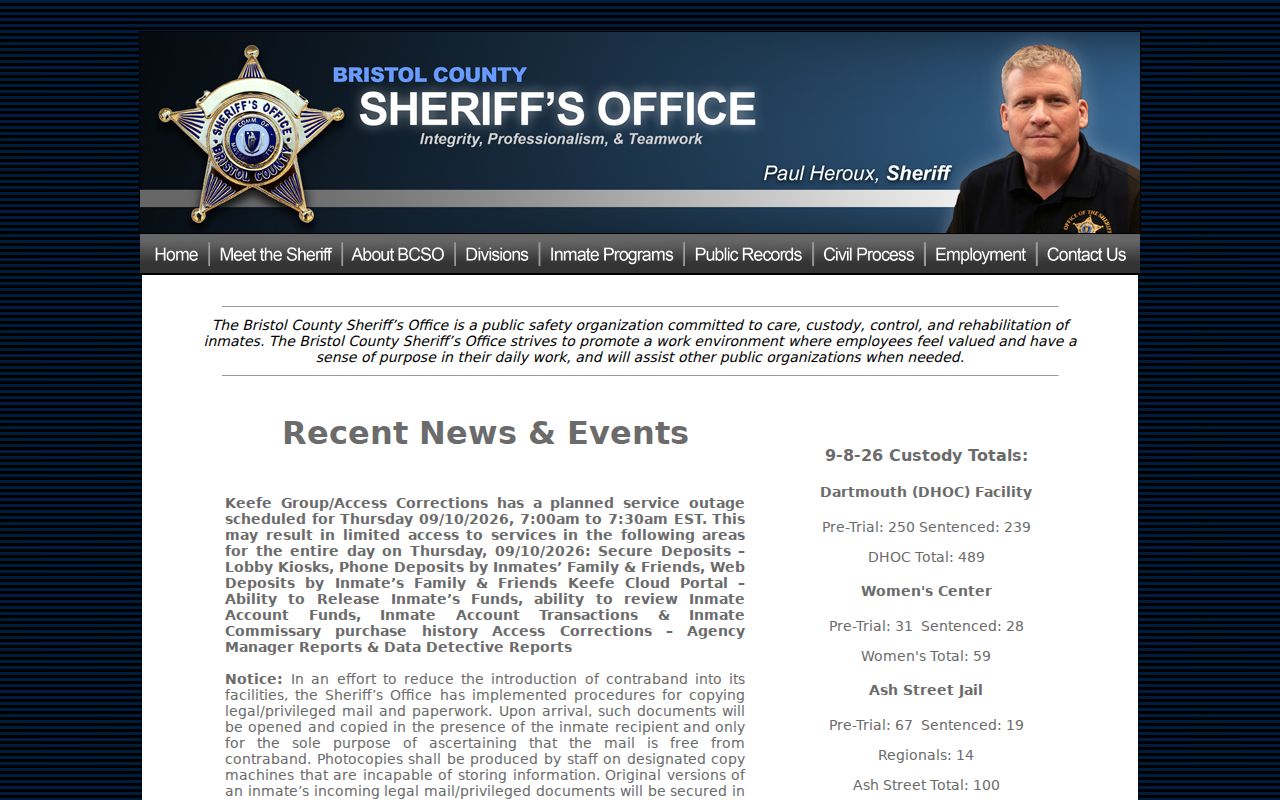
That sheriff page covers custody and bail, not a warrant list. Civil process is a separate job too. Bristol County deputies serve summonses, executions, and civil capiases through the Civil Process Division, and the fee depends on the document and the location involved.
- Default warrant
- A court order issued after a missed appearance, payment, or other required step.
- Recall
- A court action that withdraws a warrant from active status.
- Discharge
- A record update showing a default or warrant has been resolved, often after payment.
- WMS
- The Massachusetts Warrant Management System, used by courts and police to enter and check warrants.
Note: Custody and records are different counters at the same agency, so ask for the office you need.
Issuing and Serving Warrants in Bristol County
The court issues the order, and a separate agency carries it out. A clerk-magistrate at the Attleboro District Court authorizes process on a local complaint. The Bristol County Superior Court acts after an indictment instead. Massachusetts rules prefer a summons over an arrest warrant when a summons will do.
Superior criminal sessions sit in Taunton and Fall River. A Bristol County District Court clerk cannot answer for a Superior file.
| Stage | Who Acts | What Happens |
|---|---|---|
| Issuance | Judge or clerk-magistrate | Probable cause review, then a summons or a warrant |
| Entry | Issuing clerk | The order enters the state system for police and the Registry |
| Service | Police or authorized officer | The person is taken into custody or brought to court |
| Recall | The issuing court | The court withdraws or discharges the warrant and updates the record |
Online Payment Does Not Clear a Warrant
Paying a fine online feels final. It is not. The state's payment instructions warn that an electronic payment does not remove an outstanding warrant, and the person still has to contact or visit the court. Payment under G.L. c. 276, § 31 is a real route for a failure-to-pay default in Bristol County, and a court can waive the added assessment for hardship.
Note: Keep the receipt and the full case number, then ask the clerk to confirm the discharge.
If You Have a Warrant in Bristol County
Talk to a lawyer before you act. Massachusetts guidance on warrant checks says counsel may come with you, and a public defender may be appointed in eligible criminal cases. Showing up in court can still end in arrest or detention while a judge handles the case. A voluntary appearance with a plan usually beats a stop on the road, but that call belongs with an attorney who knows the file. Bring the notice. Bring the docket number, photo identification, and proof tied to the missed date too. Once a Bristol County warrant comes off, ask for written confirmation that it was removed. Keep a copy of that confirmation where you can find it.
Important: Call a lawyer before turning yourself in. An outstanding warrant can lead to arrest at any traffic stop or police contact.
Bristol County Warrant Custody and Bail
Two sheriff addresses sit a short distance apart. The jail, the House of Correction, and the public-records office are at 400 Faunce Corner Road in North Dartmouth. The Civil Process Division is at 421 Faunce Corner Road. Bail questions follow custody rather than warrants, so call 508-995-6400 and confirm the window before you drive over. Regional bail windows run on a posted schedule, weekdays and weekends, with overnight slots. Arrive at least thirty minutes early at the Women's Center security desk. Bail over $5,000 takes a bank check payable to the Commonwealth of Massachusetts. The Bristol County jail also posts state system outages, usually on a Wednesday evening each month, when warrant activity is not processed.
Bristol County Warrant Records and Public Access
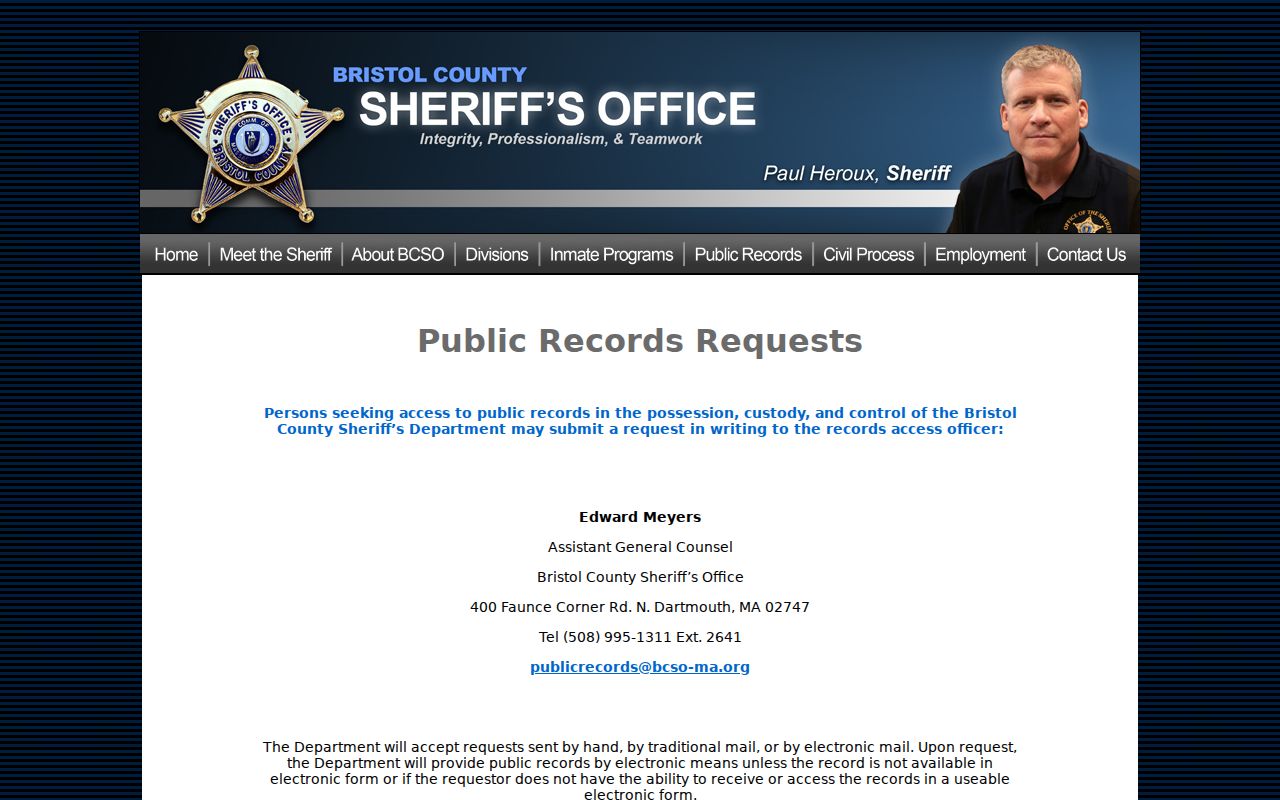
A public-records request to the Bristol County sheriff reaches agency records such as policies, logs, and counts. It never returns a named criminal history.
Bristol County court files are open by default. The Uniform Rules on Public Access to Court Records govern that access. Non-impounded records sit at the public counter during normal court hours. Courthouse kiosks also let you inspect a file or buy copies for a fee. The default bends, though, when a sealing order, an impoundment rule, a juvenile confidentiality statute, or a criminal-record restriction applies. That is why a public search can come back empty on a file that exists.
Key Rules:
Uniform Rules on Public Access to Court Records, Rule 1 - non-impounded court records are generally open for public inspection.
G.L. c. 276, § 23A - clerks enter warrant details into the state system and update it when a warrant is recalled or removed.
G.L. c. 66, § 10 - the Public Records Law covers agency records and is a separate route from a court file.
Bristol County Courts and Closed Warrant Files
Not every Bristol County file reaches a public screen. Juvenile Court sessions are closed. Juvenile records stay confidential except in narrow situations, so a juvenile warrant never appears in a public lookup. Probate and Family files hold financial, medical, and child-related material that the registry protects. The answer in each case comes from the office holding the file, not from any published list.
Note: An empty search result means the public channel shows nothing, and it never proves that no warrant exists.
Bristol County Warrants by City
Bristol County has four incorporated cities. New Bedford, Fall River, Taunton, and Attleboro each run a District Court division and a police department with its own records habits. Attleboro police publish a monthly wanted page. The other three answer records requests without any public warrant list. Ask city police for an agency record first. Then confirm warrant status with the court that holds the case.
New Bedford Warrant Records
2020 population 101,079 · District Court code 33 and city police records.
Fall River Warrant Records
2020 population 94,000 · District Court code 32, Superior sessions, and police records requests.
Taunton Warrant Records
2020 population 59,408 · District Court code 31, the Court Service Center, and Superior sessions.
Attleboro Warrant Records
2020 population 46,461 · District Court code 34 and the police department's monthly wanted page.
Bristol County Warrant Roundups and Amnesty Programs
People often ask when the next warrant roundup or amnesty week runs. None is scheduled in Bristol County. No sheriff, district attorney, police department, or Trial Court office advertises a countywide amnesty, safe-surrender weekend, or reward program. Massachusetts offers no blanket fee waiver. The ordinary route remains: ask the issuing court about a discharge and about hardship relief under the payment statute.